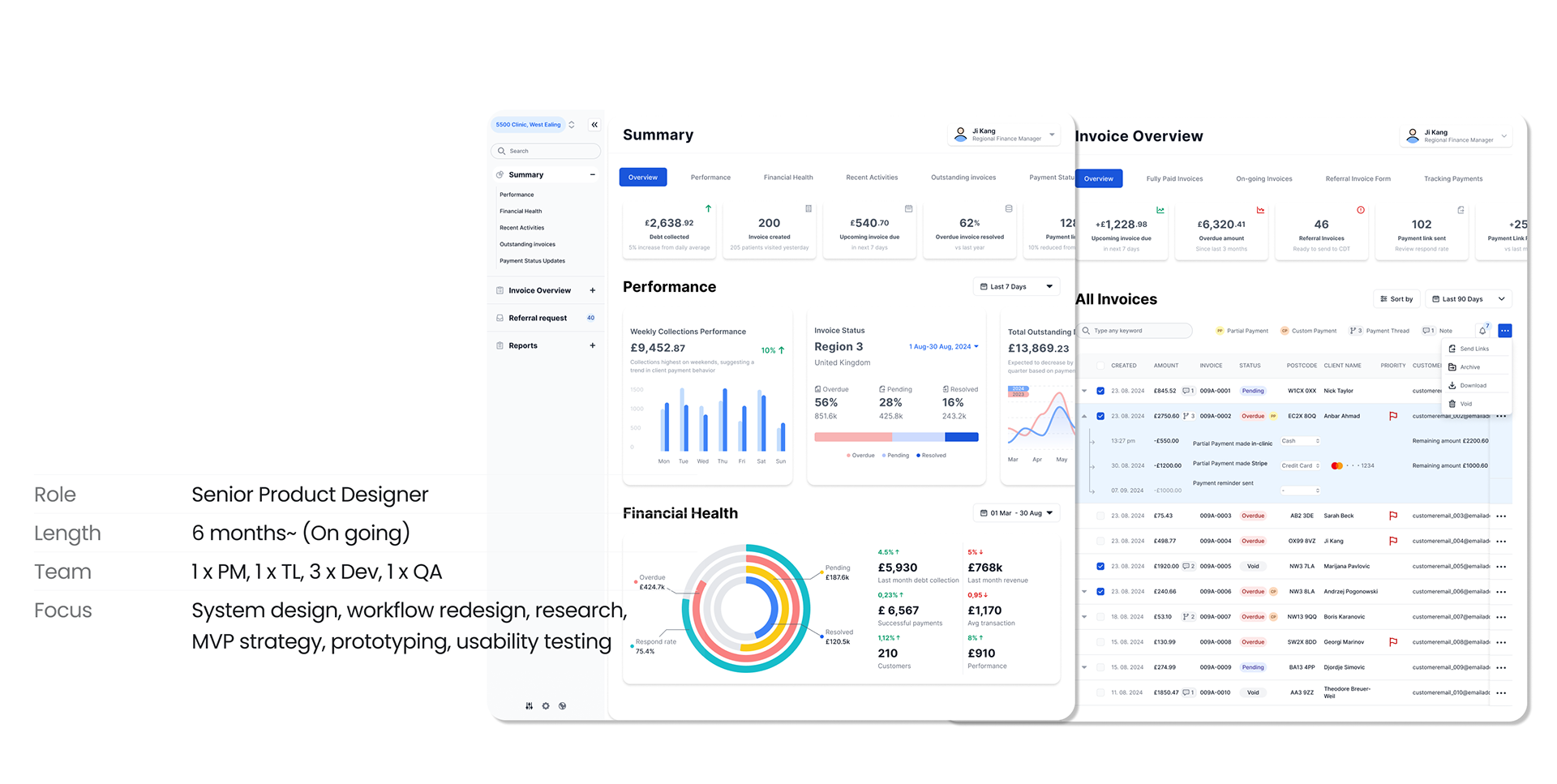
I led the end-to-end design of a scalable payment operations platform to reduce manual debt-recovery workflows across IVC Evidensia’s UK clinic network. The project focused on improving financial visibility, streamlining overdue invoice management, and modernising legacy operational systems.
01.
The Problem
50% of all outstanding debt came from just 10 clinics
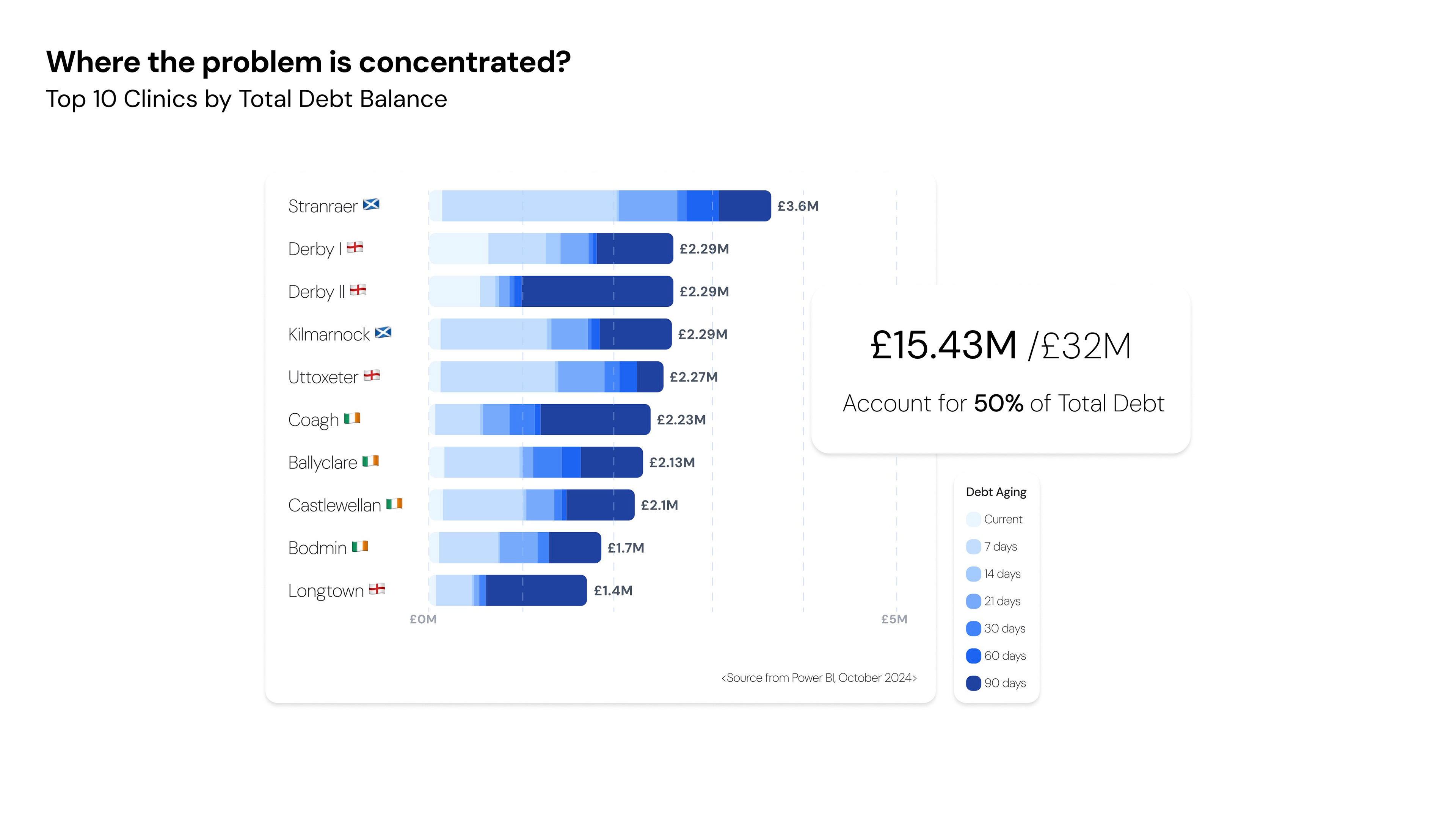
A small number of clinics were responsible for a disproportionate share of financial risk, revealing the need for better visibility, prioritisation, and intervention workflows.
Debt became significantly harder to recover over time
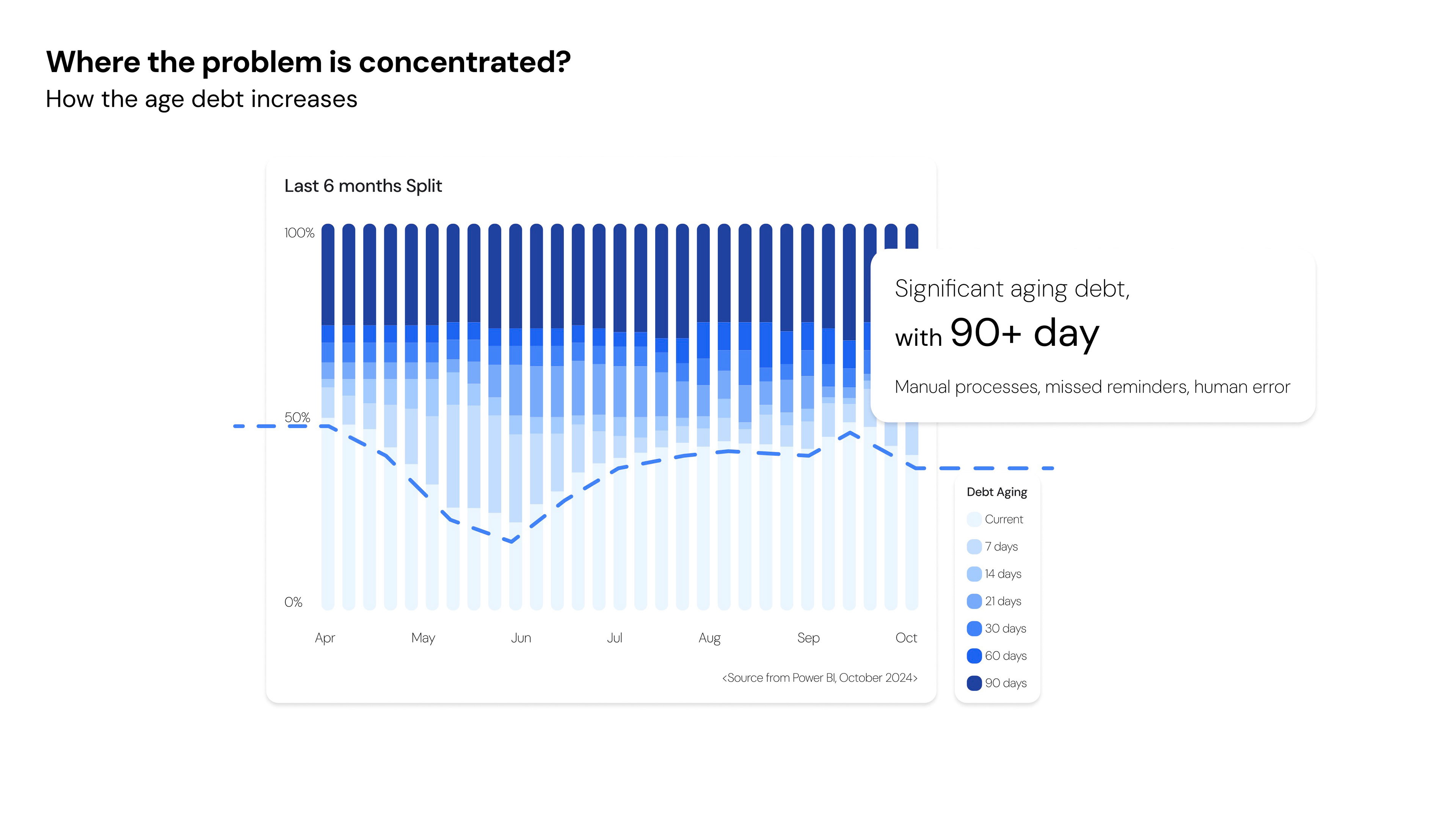
A large proportion of unpaid invoices were ageing beyond 90 days, indicating breakdowns in follow-up processes, inconsistent reminder workflows, and limited visibility into overdue accounts. The longer the debt remained unresolved, the lower the likelihood of successful recovery.
02.
Research & Discovery
To understand the root causes behind growing debt balances, I combined quantitative data analysis with user research across multiple stakeholder groups. The goal was to uncover where operational breakdowns occurred and how debt accumulated throughout the payment lifecycle.
Research included:
✦ 110 clinicians surveyed
✦ 150 pet owners surveyed
✦ 4 clinic visits
✦ Interviews with practice managers, finance teams, receptionists, and debt specialists
✦ 150 pet owners surveyed
✦ 4 clinic visits
✦ Interviews with practice managers, finance teams, receptionists, and debt specialists
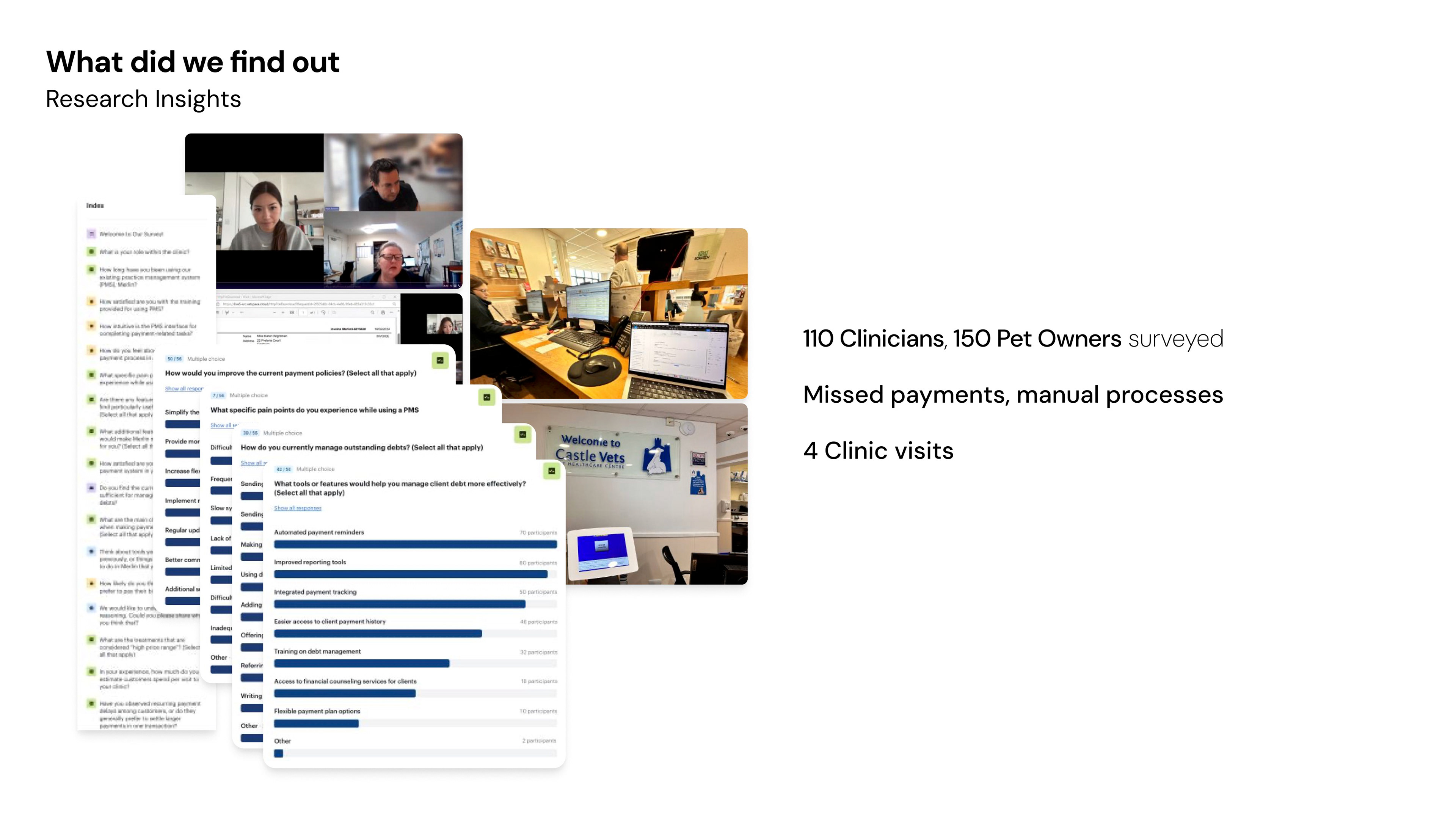
Combining behavioural and operational research
The challenge extended beyond unpaid invoices. Through surveys, interviews, and clinic visits, we uncovered a complex ecosystem of manual processes, fragmented systems, and inconsistent payment follow-up practices.
Key Insights
Clinic Staff
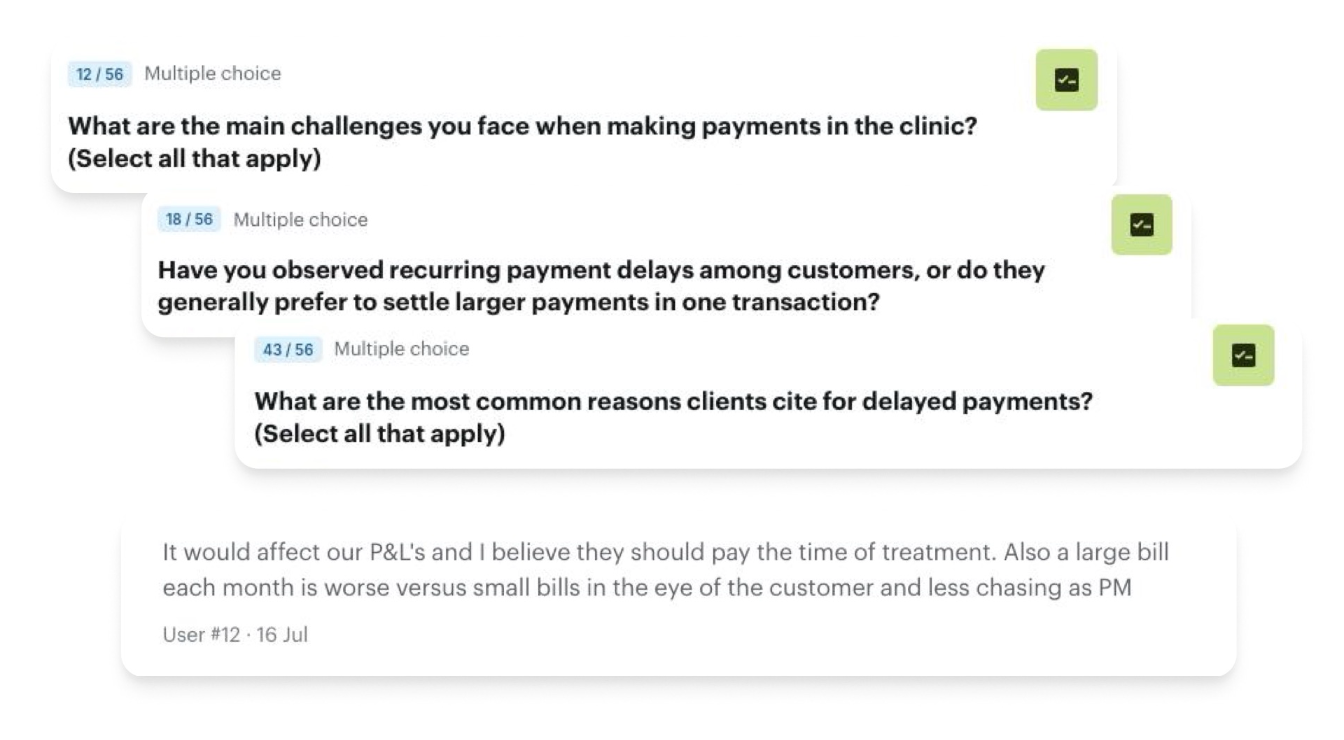
✦ 61% struggled to track outstanding payments
✦ 45% admitted payment reminders were often missed
✦ Practice managers spent up to 10 hours per week manually reconciling payments
✦ 61% struggled to track outstanding payments
✦ 45% admitted payment reminders were often missed
✦ Practice managers spent up to 10 hours per week manually reconciling payments
Pet Owners
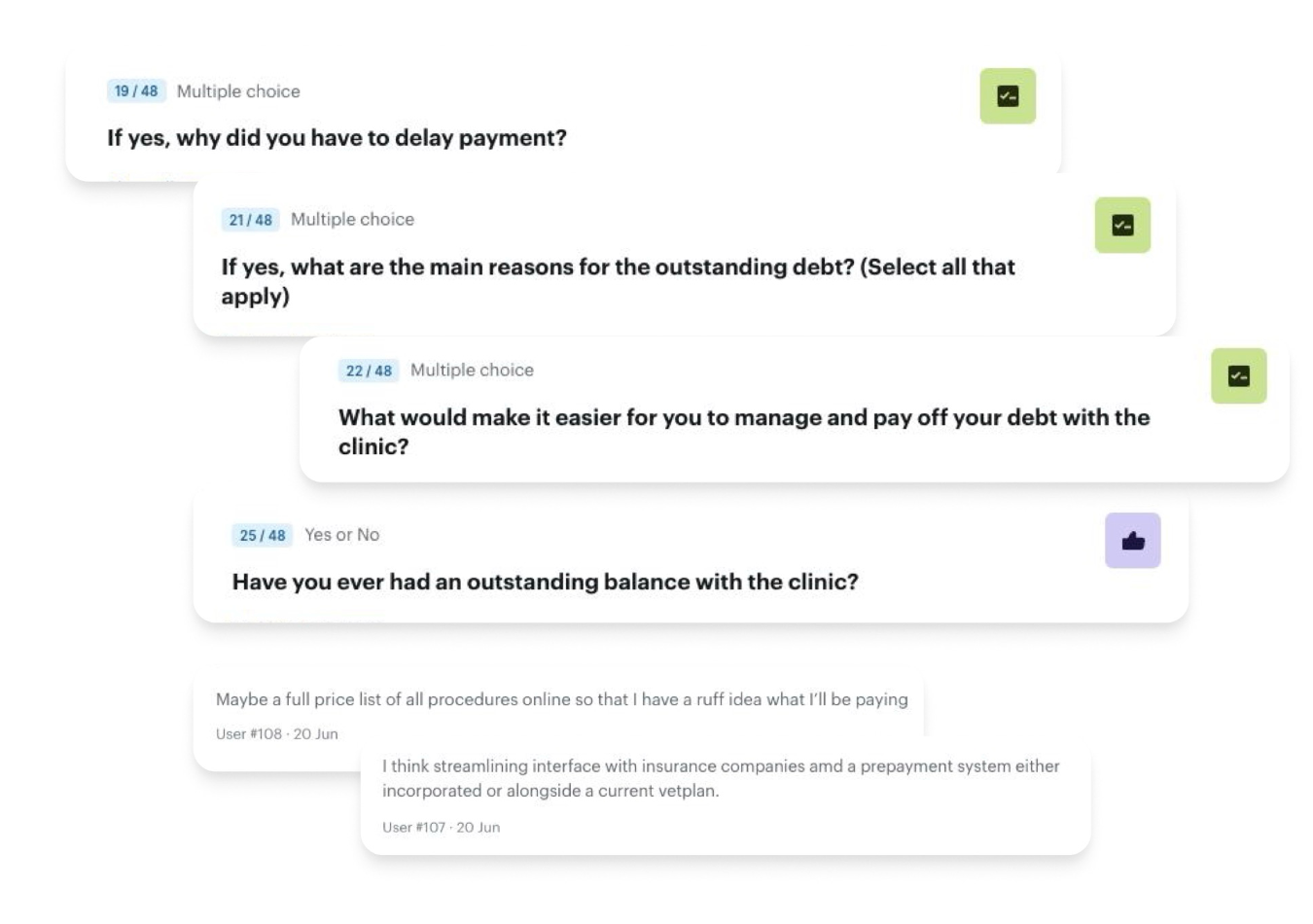
✦ 55% had experienced delayed payments
✦ 46% reported financial strain following unexpected procedures
✦ Many lacked visibility into payment options and outstanding balances
✦ 55% had experienced delayed payments
✦ 46% reported financial strain following unexpected procedures
✦ Many lacked visibility into payment options and outstanding balances
Central Debt Team
✦ Relied heavily on manual spreadsheets
✦ Debt tracking was fragmented across clinics
✦ Delays in reporting reduced the effectiveness of debt recovery efforts
✦ Relied heavily on manual spreadsheets
✦ Debt tracking was fragmented across clinics
✦ Delays in reporting reduced the effectiveness of debt recovery efforts
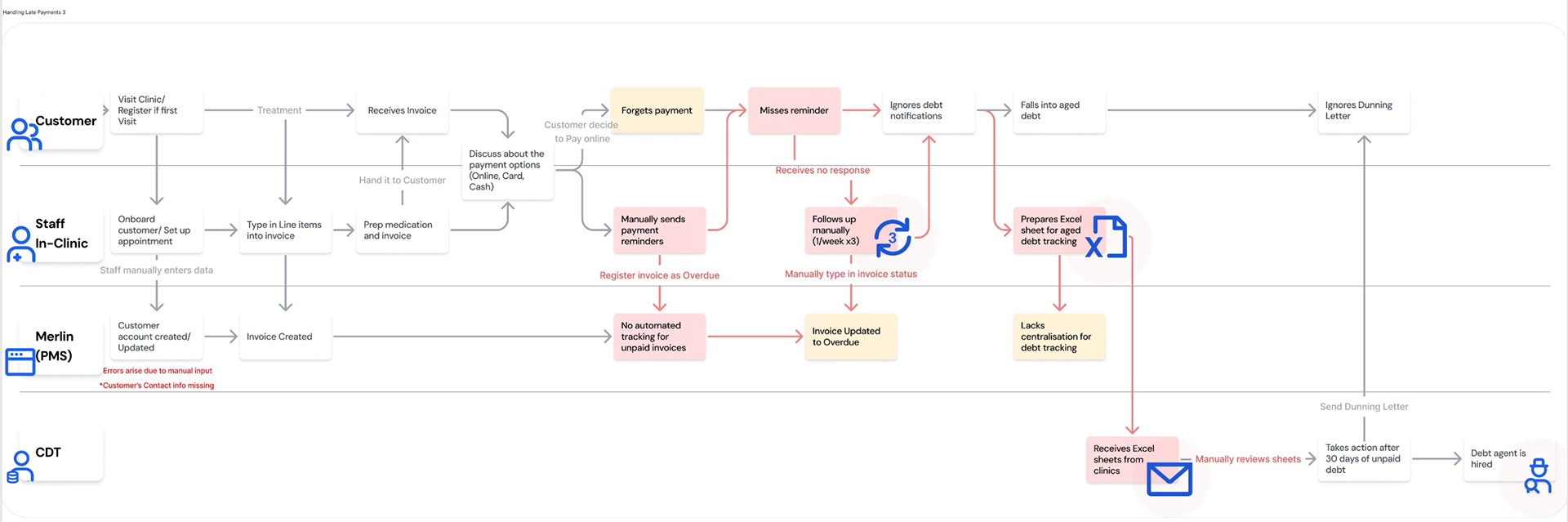
Mapping where debt entered the system
The journey map revealed that a single event rarely caused debt accumulation.
Instead, debt emerged through a chain of operational failures, including missed reminders, manual invoice tracking, spreadsheet-based reporting, and disconnected workflows between clinics and the central debt team.
Key Opportunities
✦ Automate overdue payment reminders
✦ Create a single source of truth for invoice status
✦ Improve visibility across clinics and finance teams
✦ Reduce manual reconciliation and spreadsheet dependency
03.
Reframing the Solution
Research revealed that debt recovery was only one symptom of a broader operational challenge. Clinics lacked visibility, automation, and a centralised way to manage financial workflows. Rather than designing another standalone debt collection tool, we reframed the opportunity as a scalable operational platform.
The Existing Process Was Fragmented

Debt recovery relied on a chain of disconnected manual processes involving spreadsheets, printed reports, email communication, and delayed handoffs between clinics and the central debt team.
The process lacked visibility, ownership, and automation, making it difficult to proactively manage overdue payments.
A Centralised, Automated Workflow

We envisioned a streamlined workflow where payment tracking, debt management, and recovery actions could be managed from a single platform.
By reducing manual touchpoints and improving visibility, clinics could focus on intervention rather than administration.
Strategic Shift
The key insight was that debt recovery was not the product
Debt recovery was the outcome
The real opportunity was creating a platform that enabled clinics to manage financial operations more efficiently across the entire payment lifecycle
Beyond Debt Collection
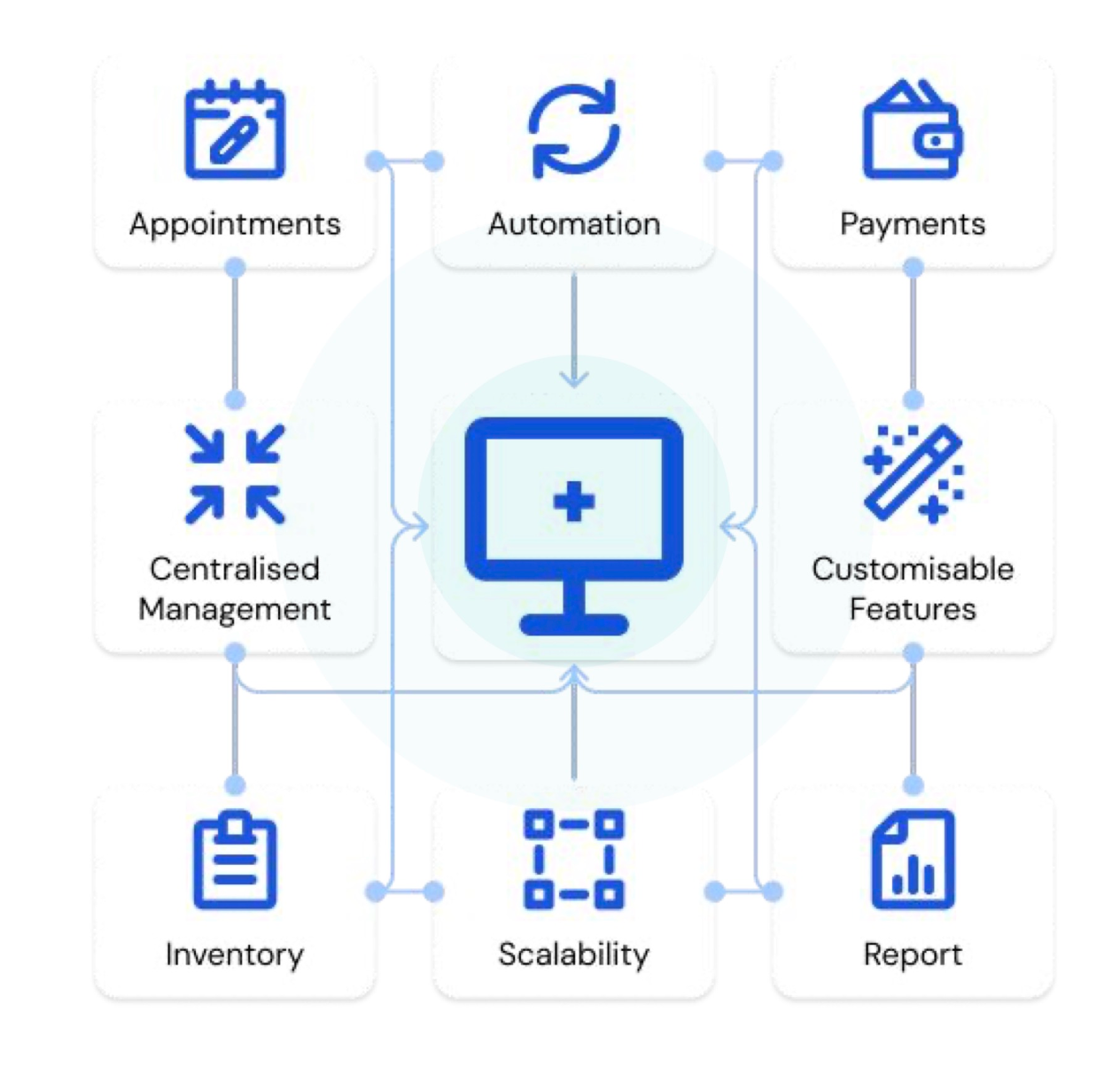
Rather than creating a single-purpose debt collection tool, I proposed a platform approach that could support future operational workflows, including payment management, automation, reporting, inventory visibility, and clinic administration.
This allowed the solution to scale beyond the immediate debt recovery problem while remaining aligned with long-term business goals.
Principles That Guided the Platform
To ensure the solution could scale across hundreds of clinics, I established a set of design principles that informed product decisions throughout the project.
✦ Visibility First
Users needed clear insight into invoice status, payment activity, and debt risk
✦ Automate Repetitive Tasks
Reduce dependency on manual reminders, reconciliation, and reporting
✦ Design for Scale
Support different clinic sizes, workflows, and future operational needs
✦ Create Consistency
Standardise debt management processes across the organisation
Users needed clear insight into invoice status, payment activity, and debt risk
✦ Automate Repetitive Tasks
Reduce dependency on manual reminders, reconciliation, and reporting
✦ Design for Scale
Support different clinic sizes, workflows, and future operational needs
✦ Create Consistency
Standardise debt management processes across the organisation
Why We Couldn't Simply Improve the Existing System
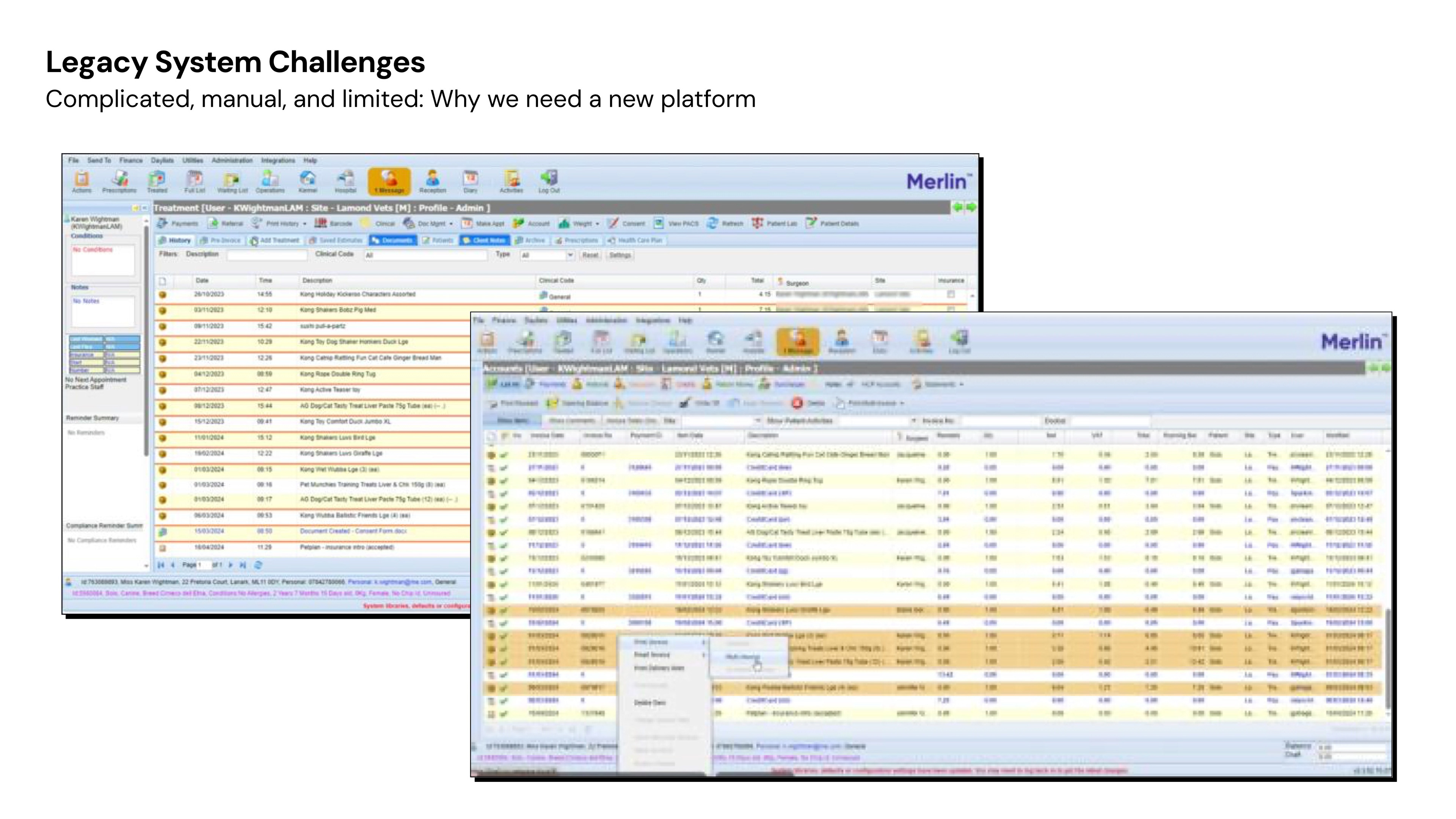
The existing Merlin PMS supported invoice management but relied heavily on manual workflows and legacy architecture. Rather than continuing to optimise an increasingly complex system, we identified an opportunity to create a dedicated operational platform that could centralise debt management and scale with future business needs.
Key opportunities
✦ Simplify Complexity
Reduce the operational burden of managing invoices and overdue balances
Reduce the operational burden of managing invoices and overdue balances
✦ Work Around Legacy Constraints
Enable innovation without being restricted by the PMS architecture
Enable innovation without being restricted by the PMS architecture
✦ Centralise Debt Management
Create a single source of truth for payment recovery workflows
Create a single source of truth for payment recovery workflows
04.
Exploration & Systems Thinking
How I translated research insights into a scalable platform strategy and design system.
Learning from Adjacent Industries
To avoid reinventing established patterns,
I analysed invoicing, payment, and operational platforms across fintech and commerce products.
I analysed invoicing, payment, and operational platforms across fintech and commerce products.
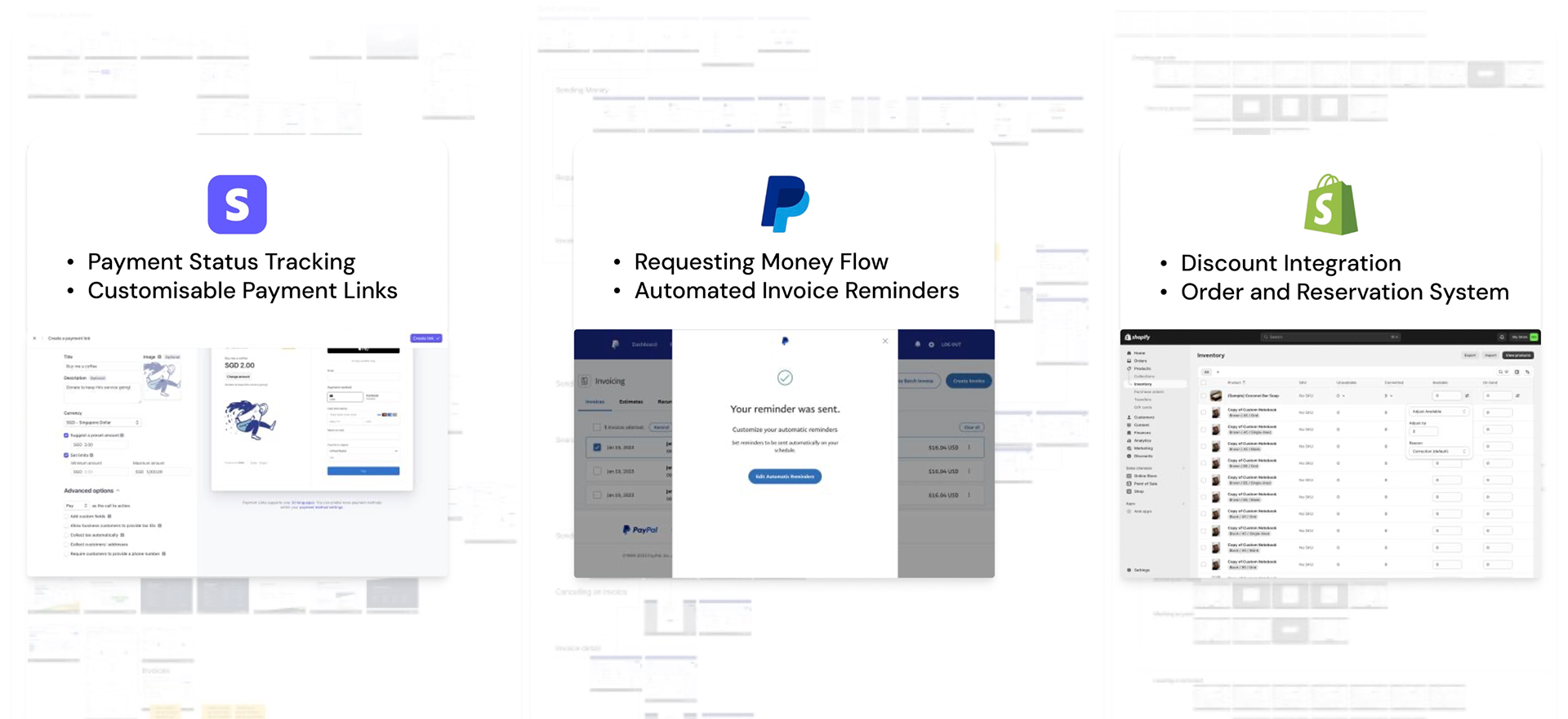
What I looked at
✦ Stripe → Payment link flexibility
✦ PayPal → Debt collection and reminder flows
✦ Shopify → Operational workflows and management systems
Key Takeaways
✦ Automated reminders reduce manual follow-up
✦ Payment status visibility improves tracking
✦ Flexible payment links support different clinic workflows
✦ Operational tools benefit from centralised management
Impact on the solution
These insights helped shape the payment workflow, invoice management model, and automation strategy for the portal
Cross-Functional Workshops
Aligning Business, Design, and Engineering
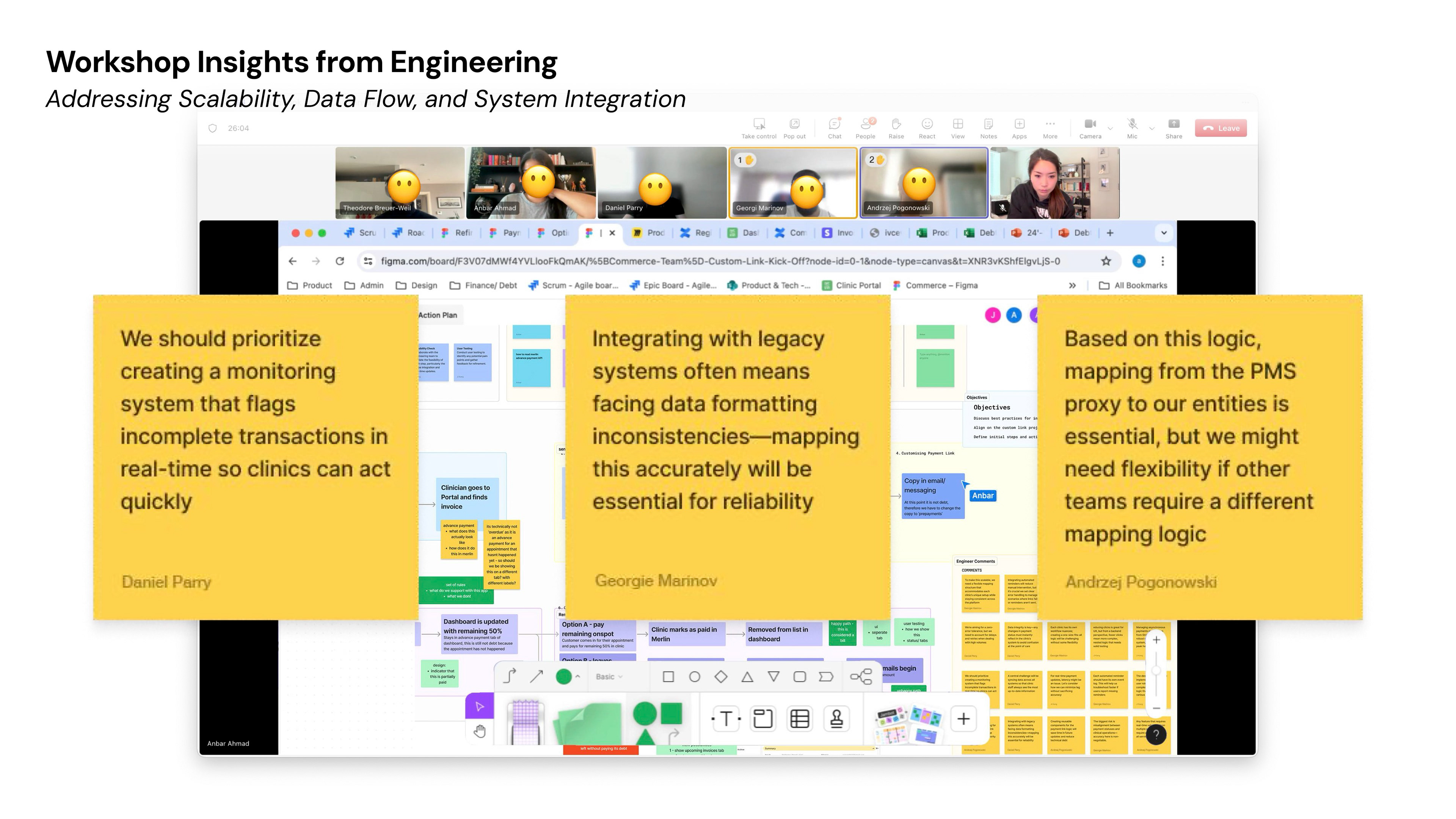
I facilitated workshops with product managers and engineers to validate assumptions, align priorities, and identify technical constraints early
Outcomes
✦ Defined MVP scope
✦ Identified critical workflow dependencies
✦ Mapped data ownership between systems
✦ Reduced implementation ambiguity
✦ Defined MVP scope
✦ Identified critical workflow dependencies
✦ Mapped data ownership between systems
✦ Reduced implementation ambiguity
Engineering Insights & Technical Constraints
Working closely with engineering revealed system-level considerations that significantly influenced the solution architecture
Key engineering considerations
✦ Data Reliability
Legacy PMS integrations introduced inconsistent data formats that required robust validation and mapping
✦ Monitoring & Recovery
Failed payment flows required visibility and recovery mechanisms to reduce manual intervention
✦ Scalability
The solution needed to support future products beyond the initial debt-management use case
✦ Data Reliability
Legacy PMS integrations introduced inconsistent data formats that required robust validation and mapping
✦ Monitoring & Recovery
Failed payment flows required visibility and recovery mechanisms to reduce manual intervention
✦ Scalability
The solution needed to support future products beyond the initial debt-management use case
Evolving the Information Architecture
As the product vision expanded, the navigation evolved from a simple invoice tool into a broader operational platform.
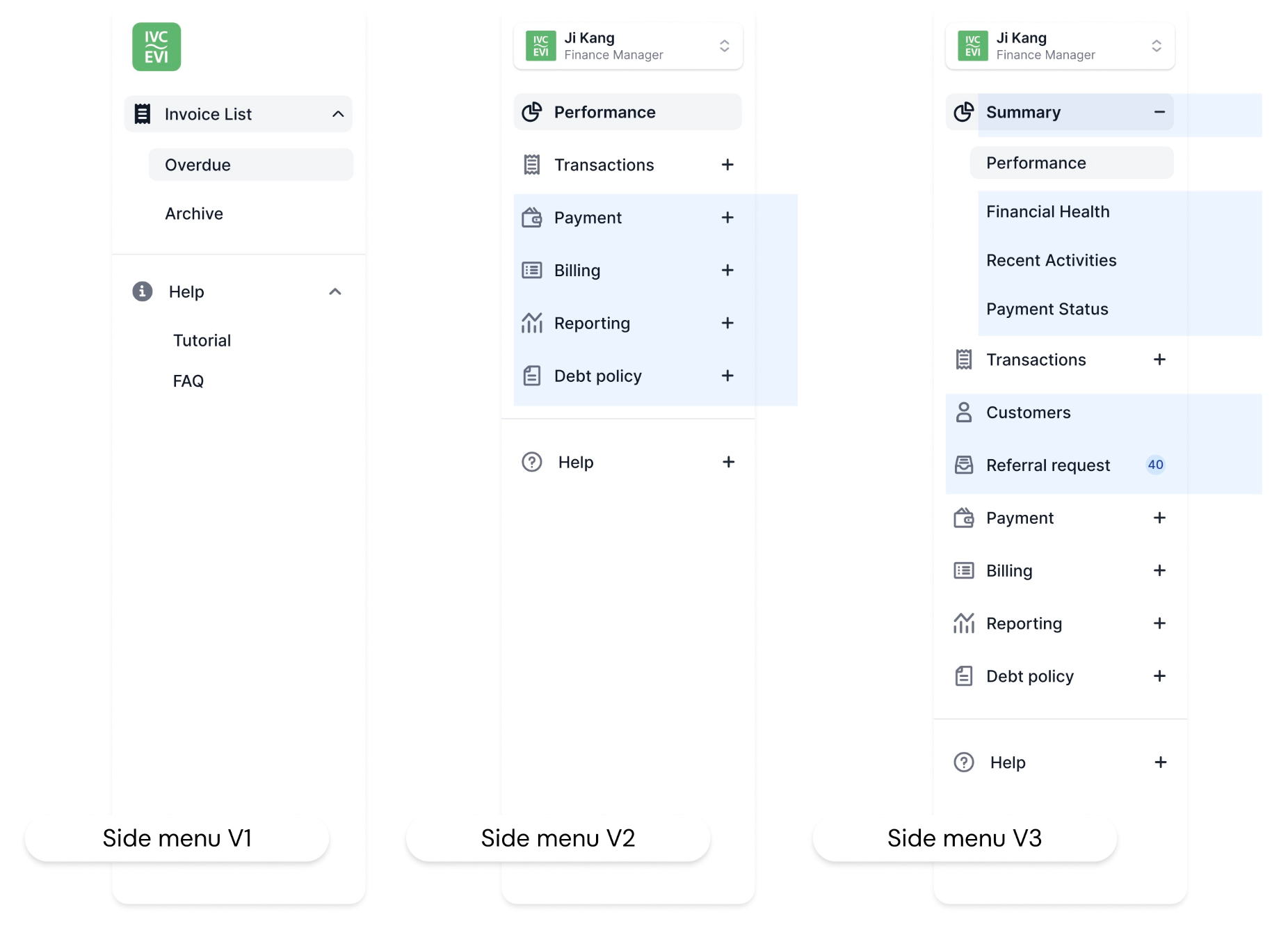
Iteration highlights
V1
✦ Focused solely on overdue invoices
V1
✦ Focused solely on overdue invoices
V2
✦ Expanded to payments, billing, and reporting
✦ Expanded to payments, billing, and reporting
V3
✦ Introduced dashboard summaries, customer management, and operational visibility
✦ Introduced dashboard summaries, customer management, and operational visibility
05.
MVP & Iteration
Building Reusable Components for Scale
Rather than designing isolated screens, I developed reusable patterns that could support future platform growth
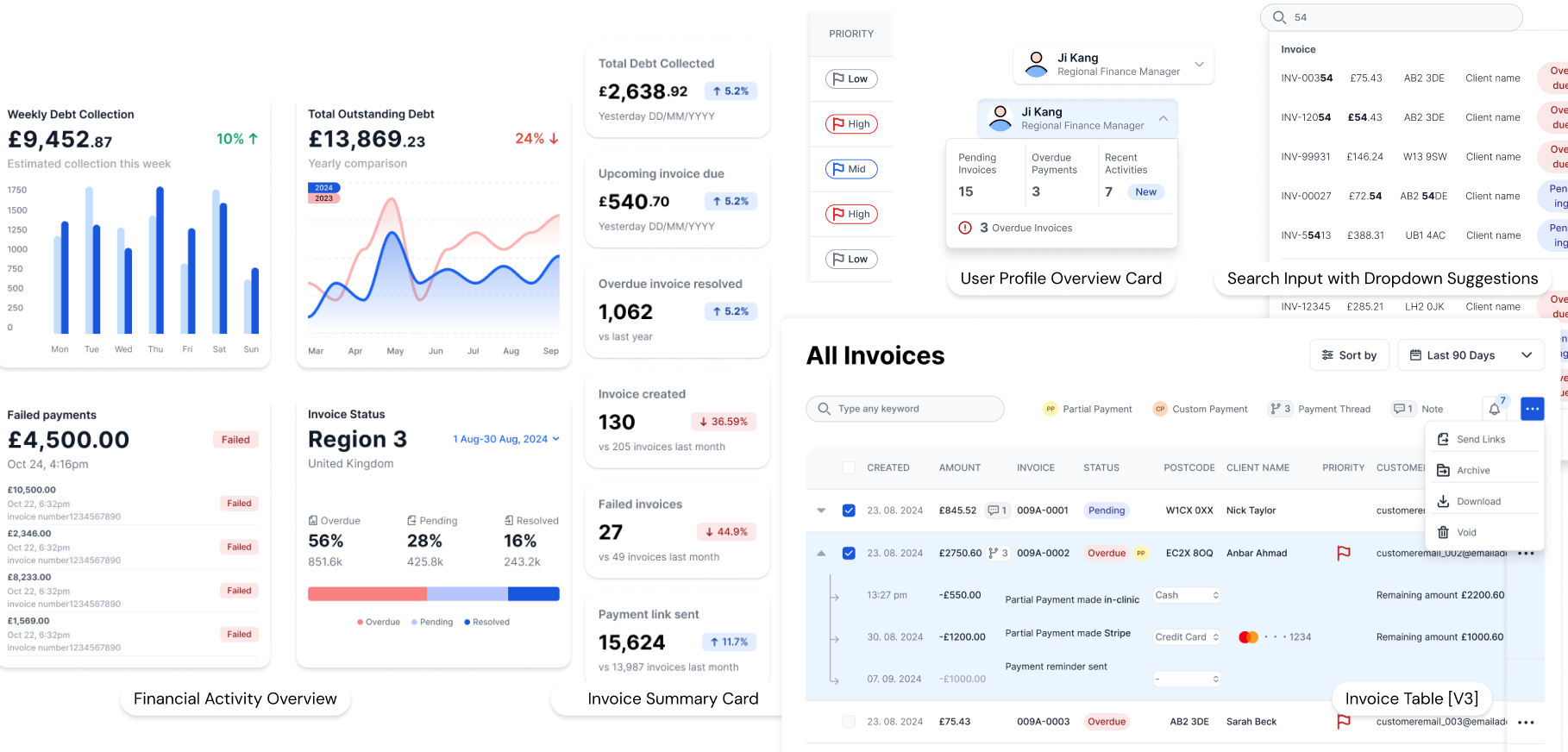
A component-driven approach enabled consistency across workflows while reducing future design and engineering effort
Components explored
✦ Financial summary cards
✦ Invoice management tables
✦ Search and filtering patterns
✦ User profile modules
✦ Priority and status indicators
✦ Financial summary cards
✦ Invoice management tables
✦ Search and filtering patterns
✦ User profile modules
✦ Priority and status indicators
Defining the MVP Scope
To align stakeholders and engineering teams, I mapped the complete MVP experience across all key user interactions and supporting screens.
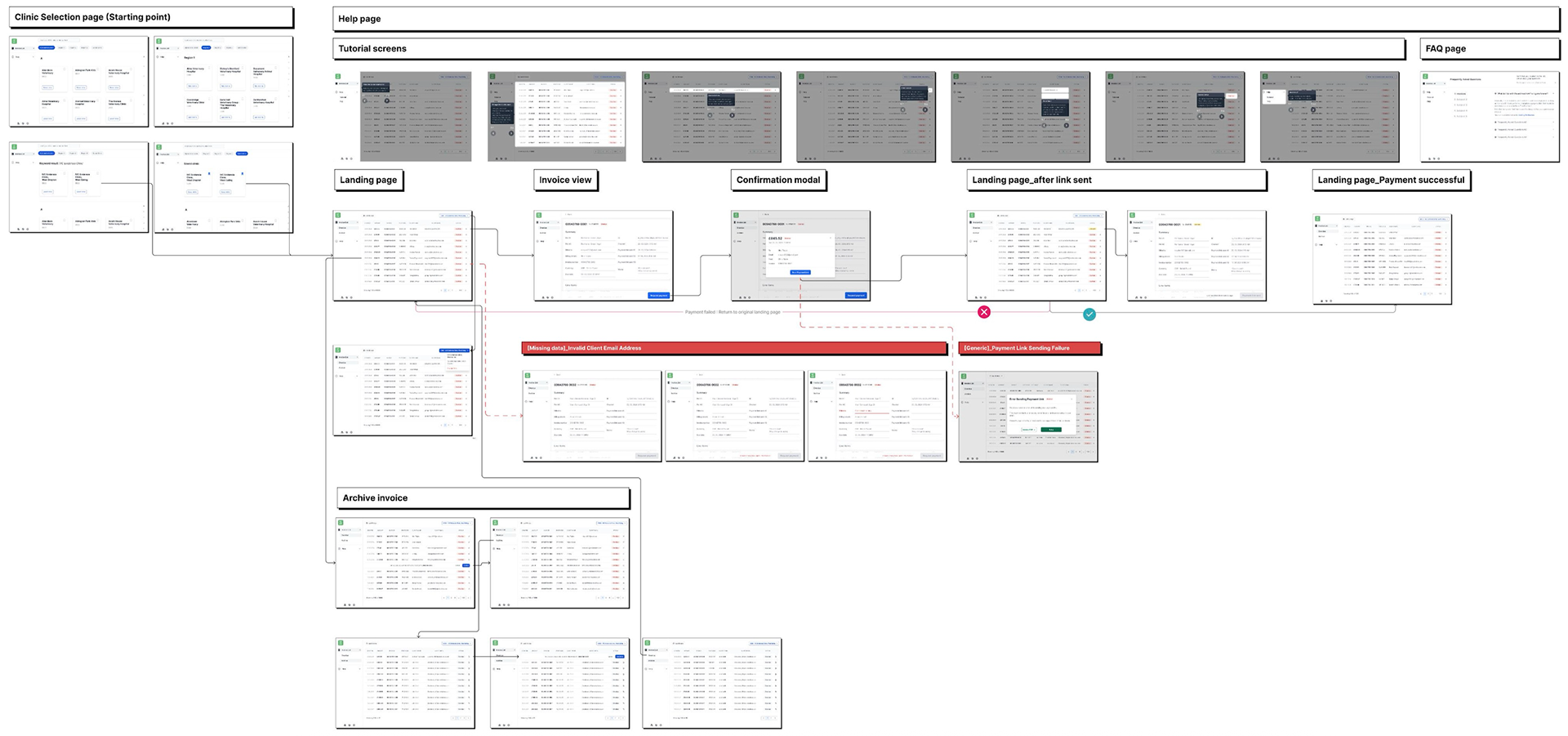
Created a shared blueprint used by design, product, and engineering throughout delivery
Included in the MVP
✦ Clinic selection
✦ Invoice management
✦ Payment link generation
✦ Confirmation workflows
✦ Help and onboarding experiences
✦ Archive management
✦ Administrative support flows
✦ Clinic selection
✦ Invoice management
✦ Payment link generation
✦ Confirmation workflows
✦ Help and onboarding experiences
✦ Archive management
✦ Administrative support flows
06.
Testing & Outcomes
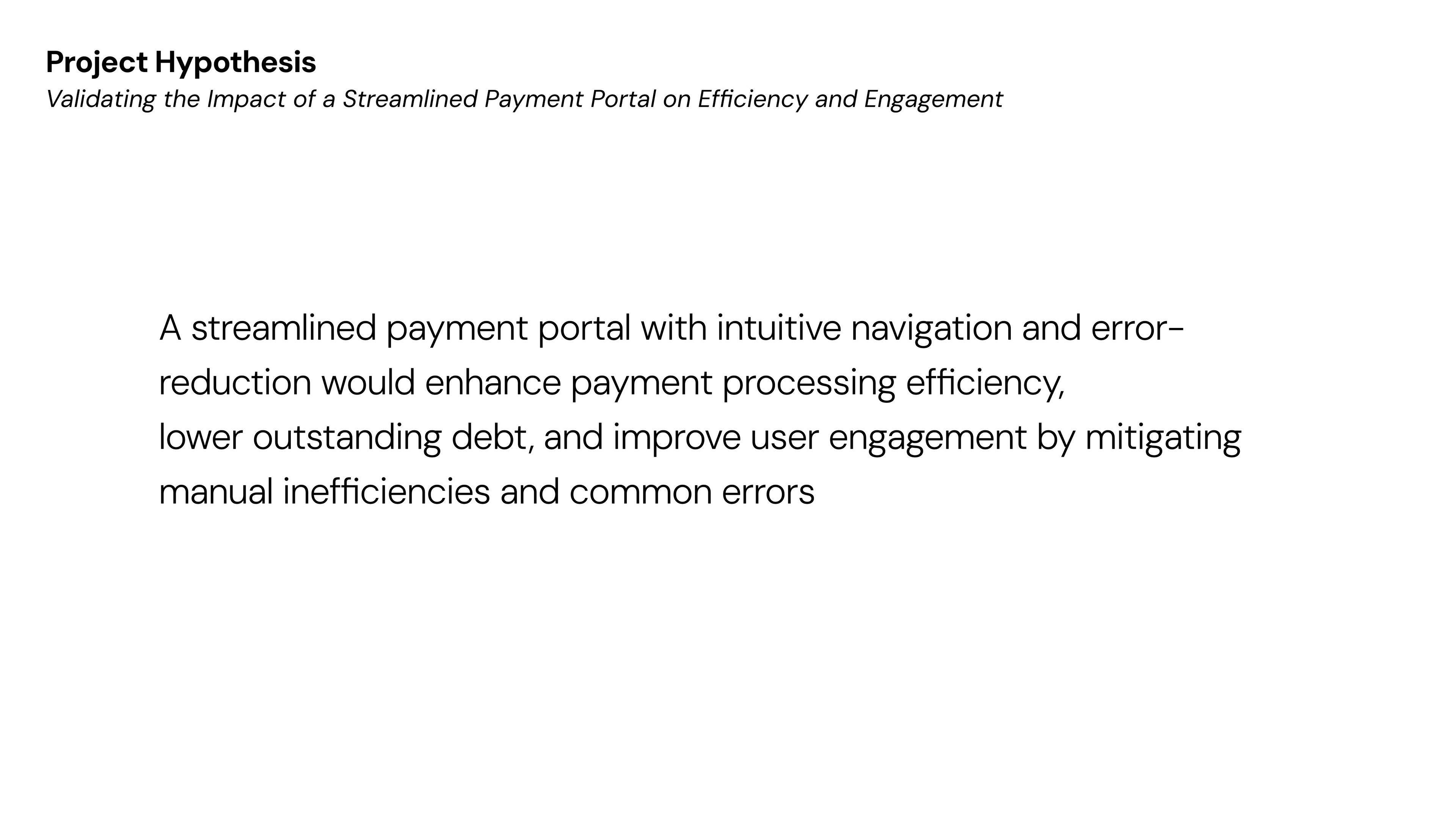
The new workflow reduced manual administration and simplified invoice management for clinic teams.
Also, allowing staff to spend less time managing debt-related administrative tasks.

Automated payment reminders and improved payment visibility helped clinics recover overdue payments more effectively.
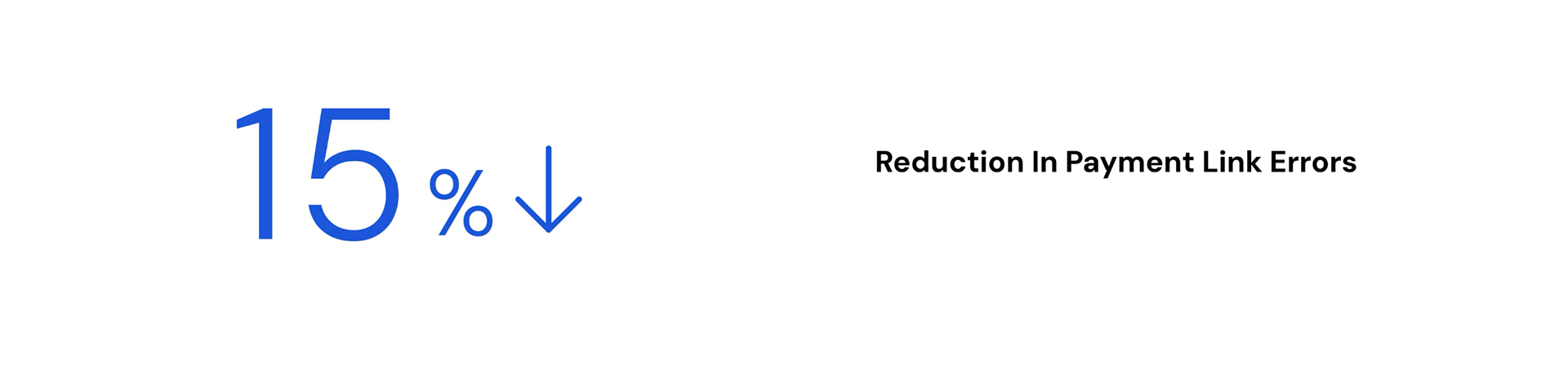
Clearer workflows, validation checks, and improved user guidance reduced common operational mistakes.
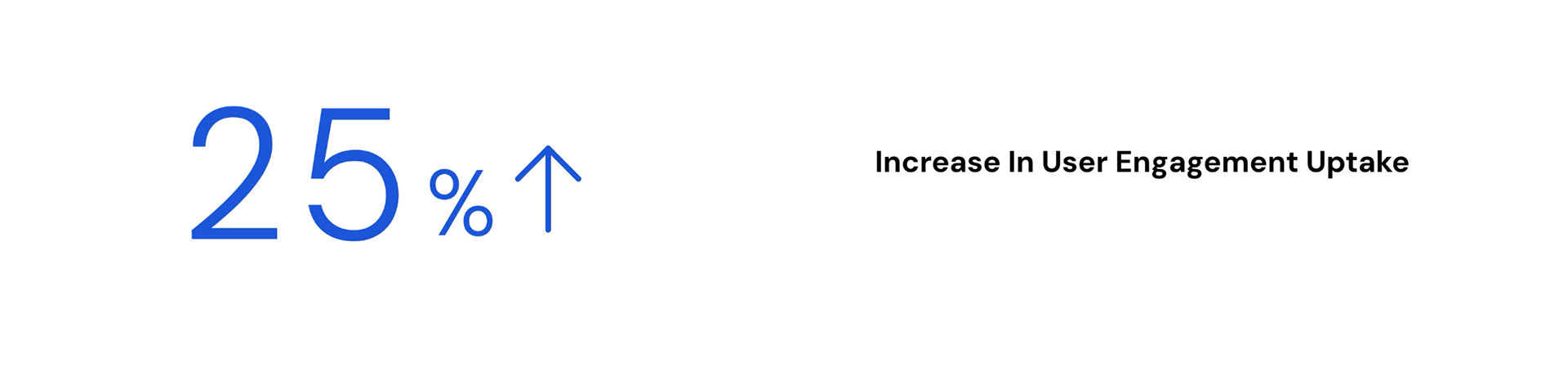
The simplified experience encouraged greater usage among clinic staff.
Key Outcomes
Operational Impact
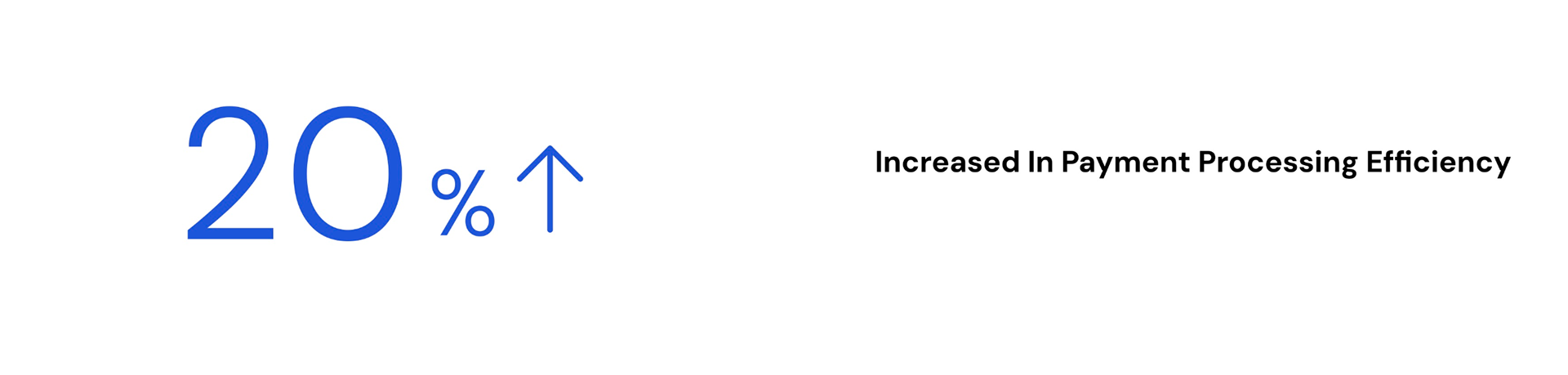
✦ 20% increase in payment processing efficiency
✦ 15% reduction in payment-link errors
✦ 20% increase in payment processing efficiency
✦ 15% reduction in payment-link errors
Financial Impact
✦ £56,000 reduction in unpaid invoices over six weeks
✦ £56,000 reduction in unpaid invoices over six weeks
User Impact
✦ 25% increase in engagement and adoption
✦ 25% increase in engagement and adoption
Business Impact
✦ The pilot validated the concept and demonstrated that centralising debt management workflows could improve both clinic operations and debt recovery performance.
✦ The pilot validated the concept and demonstrated that centralising debt management workflows could improve both clinic operations and debt recovery performance.